Heart of Darkness is a powerful and extraordinary production that left a lasting impression on me when I saw it at The Dukes, Lancaster.
I first experienced imitating the dog’s powerful story-telling skills when they staged A Farewell to Arms in 2014. To discover the show was described as “Tosh, total tosh” in the Dukes’ visitor book made me wonder if the writer of this comment just didn’t get it. Didn’t look hard enough. Because to me that’s what imitating the dog’s productions do. They make you look hard, at history, at society and at ourselves.
A Farwell to Arms was like being physically immersed in the novel, with video projection and geographical mapping breathing life into the set. This production featured real WW1 footage, text from the novel and close-ups of the actors, combined with loud and violent sound effects. It was exciting, beautiful and brutal.
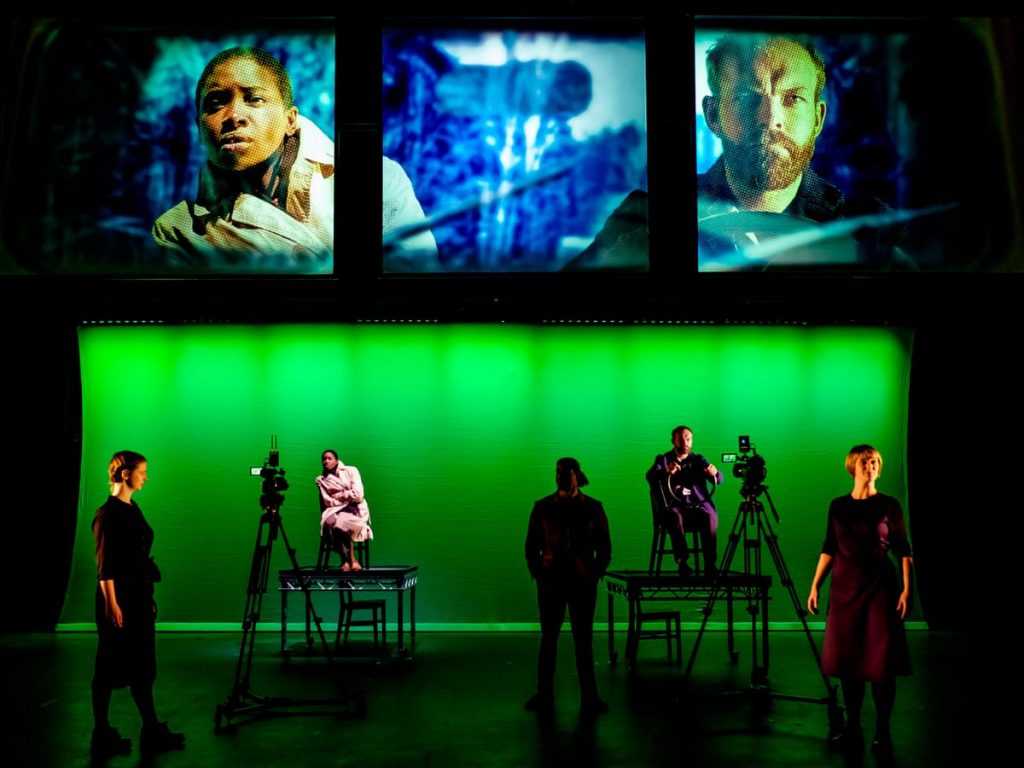
Heart of Darkness, imitating the dog’s hard-hitting, thought-provoking retelling of Joseph Conrad’s novel, is like a cinematic Russian doll, where stories within stories are revealed, captured and projected on to the stage and the screens above. Chaotic switches between layers of the old and the new battle between clips based on Apocalypse Now (the legendary Vietnamese war film also based on Conrad’s novel) and cold, hard facts.
The experience is just as immersive, but even more jolting, for it exposes the greed and horror of imperialism and the atrocities inflicted on the people of 19th century Congo during King Leopold’s colonization. Conrad’s original story is told through the narration of white British sailor Marlow, whose pursuit of ivory trader Kurtz results in a shameful recognition that darkness exists everywhere and in us all. Even in “Great” Britain.
Just like the book, the show exposes a system that enslaved the Congolese, subjecting them to tortures that included severing hands, even those of children. And why did the system continue? Because it worked. Yet despite the stark revelation of this shameful truth, Conrad’s condemnation still does not include a single black character that speaks.

How can a story, reviled as being racist, despite the author’s evident repulsion at what he himself had seen in the Congo, be told today? Discussions surrounding this, during imitating the dog’s reimagining of Heart of Darkness are cleverly injected through scenes depicting verbatim accounts of the show’s development; highlighting the actors’ surprise and objections when the directors, Andrew Quick and Pete Brooks, first announced this would be their next adaptation.
Morven Macbeth, a member of the company and cast, provided further insight when we chatted after the performance. “Attacks on Conrad’s novel include the opinion that a book which dehumanises a part of the human race cannot be considered a work of art, and that’s a valid argument, but does that mean it should be burnt and never read again?
“We wouldn’t dream of staging that story today where there is no black voice, only white male voices. But it’s a story that needs to be told, and not one we learn about in school. We looked at how we could retell the story, and the protagonist became a black female from Kinshasa, in 21st century, war-torn Europe. We made choices about what to tell and how to tell it.”
What was the thinking behind the multiple screens and cameras? “We based it on how young people take in information – multi-tasking between screens. We’re not expecting the audience to do all of that, we are reflecting the idea, where you might be watching something then look it up on Wikipedia. Yet our audience is broad, from teenagers to people in their 60s and 70s, and visually the cinematic approach works and is engaging for all.
When it comes to themes, we agree these are timeless. Morven confirms: “This is a story of capitalism and how its greed infects society. It talks about trading and it has notions of Brexit and all the rhetoric, and it questions the British perspective but it’s not a Brexit show.
“Our approach is didactic, not passive, but we are not telling the audience what to think, we are inviting them to think, and to leave with a mindset to enquire about what we haven’t been told and what we should be told.”
This show has definitely had the desired effect on me and will remain as unforgettable as Morven’s most impactful words: “History is written by the victor; theatre and the cinema are places for the real stories to be told and learned from. Heart of Darkness is part of all of us whether we like it or not.”
Watch Heart of Darkness online:
Read Cameron’s review of Heart of Darkness.