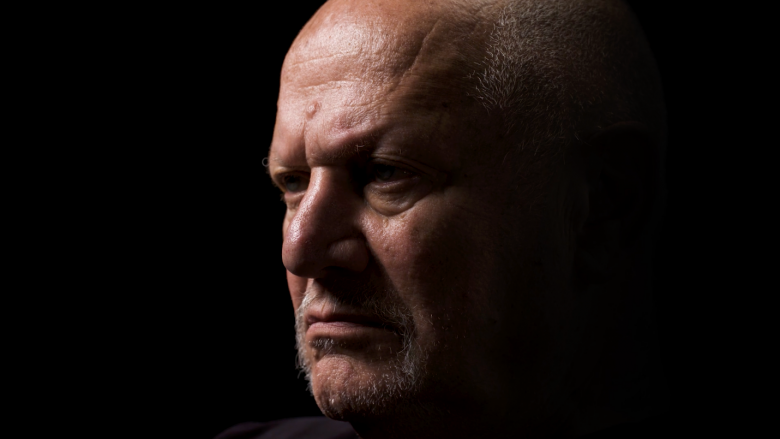
Over five decades Steven Berkoff has earned a formidable reputation for his pioneering work. I was fortunate enough to interview him as he celebrates the release on DVD and digital platforms of his spine-chilling film, Tell Tale Heart.
You wrote the screenplay for and starred in The Tell Tale Heart, and are also known for your work as a director and practitioner. In which of these roles involved in producing a piece of drama do you find the most enjoyment?
I find all the roles equally enjoyable, particularly directing.
As a practitioner, you’re famous for your non-conformist, Total Theatre methods. Some of the films you’ve featured in as an actor are of a more naturalistic style. How do you feel when a director asks you to act in a way that does not necessarily agree with the methods of drama involving heightened physical and vocal techniques you are commonly associated with?
If I’m being paid I do what I’m told and the director has his own vision which must be respected.
In Tell Tale Heart, the main character seems to, at points, discuss the intricacies of the murder and subsequent cover up in a blasé manner that does not conform with the weight of his actions. In your opinion, is this apathy a result of the man’s psychosis and indifference to the concept of murder, or of his certainty that the deed is totally justified?
In Poe’s world the dynamics of drama make murder just another flavour on the menu.
Having studied you as a practitioner myself, performing monologues in the style of Total Theatre, the hardest thing for me was not allowing the excessive movement and expression to throw me off my lines. What would you recommend to combat this issue?
Make the movement as expressive as the language.
You’ve also performed this story as a one-man show, in which version did you find the most enjoyment as an actor and how did you vary your methods?
As a one man show one has the possibility of scrolling down the library of all one’s abilities and changing even nightly.
How does the preparation to perform a role in your style differ from that of a more naturalistic role?
Preparation needs to be more daring and outlandish and far more descriptive.
I read an article in The Stage where you say your non-traditional approach has been an obstacle to success. You’re considered to be one of the most influential figures in British theatre practice so clearly your work is hugely appreciated. Why do you think Total Theatre it isn’t more widely represented in the mainstream?
It is being represented more and more, it’s sneaking up and eventually will become the mainstream.
I’ve read that some of your influences were Franz Kafka, Edgar Allen Poe, Shakespeare and Sophocles. Was there a specific piece of work that you could identify as lighting the spark in you to pursue a career in theatre?
My first work was Kafka’s In The Penal Colony, I found it so enthralling that I had to put it on stage.
I felt that preparing a monologue from Mike in West helped me with the more flamboyant movements common when performing a number from a musical which draws closely on the vaudevillian routes of musical theatre. Are you a fan of musicals and have you seen elements of your own methods in any particular show?
I am a fan of some musicals; Three Penny Opera, 42nd Street and Hair.
You won Best Actor at a number of film festivals for Tell Tale Heart, and are renowned for playing the villain in movies such as Clockwork Orange, The Krays, and more recently Harvey Weinstein in the stage play Harvey. Do you find your methods lend themselves more to playing the “bad guy”, and are these type of characters more enjoyable to play?
Bad guys are always fascinating to play since they contain so many malevolent flaws which you are obliged to examine.
If you were to play a character from Shakespeare, which one would you choose?
Othello, since no one expresses passion in the way he does.
Out of all of your work, can you single out any one (be it as an actor, director, playwright etc.) that you’re most proud of?
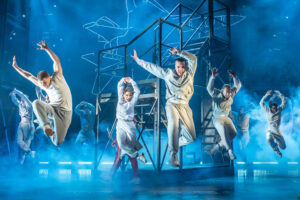
Eugene O’Neill’s The Hairy Ape which I directed at The Odyssey Theatre in Los Angeles.

Steven Berkoff is one of the most influential names in British theatre. Renowned worldwide for his unconventional, powerful and controversial style, Steven’s plays and adaptations have been performed in many countries and in many languages.
His adaptations created for the stage include Kafka’s Metamorphosis, The Trial, Agamemnon after Aeschylus, and Poe’s The Fall of the House of Usher; and Steven has directed and toured in productions Shakespeare’s Coriolanus, also playing the title role, Richard II, Hamlet and Macbeth, as well as Oscar Wilde’s Salome.
Steven’s screen work includes roles in A Clockwork Orange, Barry Lyndon, Octopussy, Beverly Hills Cop, Rambo, Under the Cherry Moon, Absolute Beginners and The Krays. He directed and co-starred with Joan Collins in the film version of his play Decadence, and his stage play Shakespeare’s Heroes and Villains was also adapted for film, directed by Stephen Cookson.
Read my review and see the trailer for Tell Tale Heart here.